Běn Cǎo Gāng Mù: Compendium of Materia Medica
An encyclopedic compendium reorganizing substances, names, preparations, uses, and natural-historical observations.
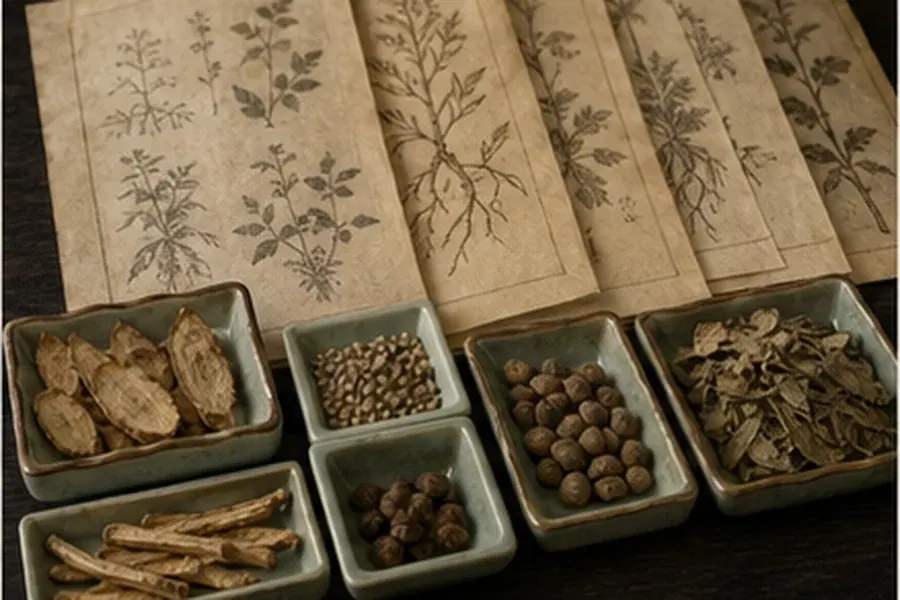
About the work
- Chinese title
- 本草纲目
- Pinyin
- Běn Cǎo Gāng Mù
- Period
- Ming, published 1596
- Category
- Materia medica
- Authorship
- Written by Li Shizhen over decades and published posthumously.
- Structure
- 52 scrolls with 1,892 entries in the traditional edition, grouped into mineral, plant, animal, and other categories.
Legacy
Its lasting innovation is taxonomic: reordering materia medica by natural affinity rather than by the inherited three grades. It shaped later pharmacopoeias inside and outside China and was inscribed on the UNESCO Memory of the World register in 2011.
- Correction and comparison of earlier names.
- Natural history and preparation methods.
- Major influence on later pharmacopoeias.
Li Shizhen and the Gangmu’s three decades
Who the author was, what drove him to write, and why the book appeared after his death.
Li Shizhen (1518-1593) was born in Qizhou, in present-day Hubei, the son and grandson of physicians. After failing the provincial examinations three times he abandoned the official career for medicine; he served at the court of the Prince of Chu and spent time at the Imperial Medical Academy. What drove him to write was not a shortage of repertories but their contradictory abundance: names that designated different plants, errors copied for centuries, attributions never checked. He worked on the Gangmu for some twenty-seven years, consulted hundreds of works, and rewrote the manuscript three times.
He never saw it printed. He considered the text finished around 1578, spent years looking for a publisher, and died in 1593; the first edition, known as the Jinling edition, came off Hu Chenglong’s press in Nanjing in 1596. His son Li Jianyuan presented it to the throne that same year with a memorial. It is worth remembering that this was a private undertaking: unlike the Xinxiu Bencao of 659 or the Song-period Zhenglei Bencao, no state office commissioned or funded it.
- Li Shizhen (1518-1593) came from a family of physicians in Qizhou, Hubei.
- The stated motive of the book is to correct errors accumulated in earlier bencao.
- Close to three decades of work and three successive redactions of the manuscript.
- Published posthumously in Nanjing in 1596, three years after his death.
Jinling edition 金陵本 The first printing of the Bencao Gangmu, Nanjing, 1596. It is the witness closest to Li Shizhen’s manuscript and the benchmark against which all later editions are collated.
Fifteen centuries of accumulated bencao
The genre the work belongs to and the chain of texts it inherits and corrects.
A bencao is not a treatment manual but a repertory of substances: each entry gives names, origin, appearance, ascribed properties, and recorded uses. The genre advances by cumulative citation. The Han-period Shennong Bencao Jing was glossed by Tao Hongjing around 500; the Xinxiu Bencao of 659 was the first state-sponsored repertory; and Tang Shenwei’s Zhenglei Bencao, from the early twelfth century, gathered that whole mass while scrupulously citing its sources. The last of these is the Gangmu’s immediate foundation.
The inheritance carried an architectural problem. The Shennong Bencao arranged substances in three grades — upper, middle, lower — by declared toxicity and fitness for prolonged use, a criterion that grouped materials with no natural relation to one another. As entries multiplied, that classification stopped helping anyone find anything. Li Shizhen did not add a storey to the inherited building: he replaced its foundations.
- A bencao records substances, names, and ascribed uses; it does not reason through clinical cases.
- The genre advances by citation: each work quotes the previous one and marks its additions.
- Tang Shenwei’s Zhenglei Bencao is the direct base on which Li Shizhen works.
- Of the Gangmu’s 1,892 entries, 374 are new additions; the rest is inheritance.
Zhenglei Bencao 证类本草 A repertory compiled by Tang Shenwei around 1108 that preserved much of the earlier bencao literature by quoting it. Without it, a great deal of previous materia medica would have vanished without trace.
Gang and mu: the taxonomic reform
What the title means and how it reorders nearly nineteen hundred entries by natural affinity.
The title announces the method. Gang is the heading rubric; mu, the subheadings that depend on it. Li Shizhen applied the pair at two levels. Across the work, sixteen sections — waters, fires, earths, minerals, herbs, grains, vegetables, fruits, trees, clothing and utensils, insects, scaly creatures, shelled creatures, birds, beasts, and the human being — are subdivided into sixty classes. Within each entry, the substance name serves as gang and the descriptive rubrics that follow it as mu.
The order of the sections follows a stated logic: first water and fire, which the author holds to precede everything else; then earth, mother of things; then the minerals that come from it; and then plants and animals, “from the small to the large” and “from the humble to the noble”, ending with the human being. It is a scale of nature with cosmological and moral roots, not an evolutionary sequence: reading it as a forerunner of modern biological classification projects backwards a question the sixteenth century was not asking.
- Gang is the heading rubric; mu, the subheadings that depend on it.
- Sixteen sections divided into sixty classes replace the inherited three grades.
- The ordering criterion is declared natural affinity, from mineral to human.
- The system makes the work searchable: for the first time one can look things up by kind.
Gang Mu 纲目 “Rubric and subrubric”. An expression from historiographical vocabulary — Zhu Xi’s Tongjian Gangmu had made it famous — applied here to the ordering of materia medica.
Anatomy of an entry
The fixed rubrics under every substance, and where the author actually speaks.
Each substance unfolds through a fixed set of rubrics, and that regularity is what turns the Gangmu into an instrument of consultation. Shiming clarifies names and their variants; jijie gathers what earlier authors said about origin, habitat, and appearance; zhengwu corrects specific errors; xiuzhi describes preparation; qiwei gives nature and flavor within the classical model; zhuzhi lists recorded uses; faming carries Li Shizhen’s own analysis; and fufang appends ascribed formulas.
The decisive distinction for a modern reader lies between jijie and faming. The first rubric compiles other voices and attributes them; the second is where the author speaks in the first person, accepting, qualifying, or rejecting. The more than eleven thousand appended formulas come mostly from earlier sources and are recorded as evidence of what was used, not as verified recommendation. No rubric contains what we would now mean by clinical indication or dosage.
- Eight fixed rubrics: names, compilation, correction, preparation, nature and flavor, uses, analysis, formulas.
- Jijie compiles other people’s sources; faming is Li Shizhen’s own voice.
- More than eleven thousand appended formulas, mostly inherited from earlier repertories.
- Zhuzhi records attested historical uses; it is not a list of current indications.
Fa Ming 发明 “Elucidation”. The rubric in which Li Shizhen sets out his own judgement on a substance. It is the part of the book where there is an author, and hence the part historians quote most.
Exact observation, textual criticism, and folklore
The book’s mixed texture, and why it is best looked at without idealizing or dismissing.
The Gangmu contains pages of remarkable precision. Li Shizhen described the poisoning of miners who went down with oil lamps following lead veins, with their sallow pallor, abdominal distension, and outcome; he dated the appearance of alcohol distillation to the Yuan dynasty; and he dismantled, quoting them one by one, the claims of earlier repertories that declared mercury harmless, recalling how many people had died seeking longevity in it.
The same book carries material nobody would defend today: sympathetic-magic remedies, a whole section on clothing and utensils and another on substances of human origin, and marvellous tales accepted unfiltered. Both faces coexist because Li Shizhen’s criterion was coherence between testimonies plus his own experience, not a procedure of proof. Acknowledging this does not diminish the work: it places it in its century, which is the only way to read it profitably.
- An early description of occupational poisoning among lead miners.
- Explicit criticism of the bencao that had declared mercury free of toxicity.
- Natural-historical and technical observations, such as dating distillation to the Yuan.
- Alongside them, sympathetic magic, substances of human origin, and legendary reports.
Zheng Wu 正误 “Correction of errors”. A rubric for flagging and amending mistaken claims in earlier works. Its systematic presence is what gives the Gangmu the character of a critical edition.
Textual heritage, not a consumption catalogue
Unstable botanical identity, toxic substances, protected species, and reliable editions.
Three problems make it impossible to use a Gangmu entry as a guide to use. The first is identity: one Chinese name has designated different species by period and region, and the substitution of plants by others of the genus Aristolochia is documented as a cause of severe nephropathy and urinary-tract cancer. The second is toxicity: the book describes mercury, lead, arsenic, and cinnabar among the materials in its repertory. The third is legal.
Animal-derived entries such as rhinoceros horn, tiger bone, pangolin scales, or musk come from species protected by CITES: trading in them or using them is illegal in most countries and fuels poaching. They must not be used under any circumstances. To this is added an editorial problem: many modern reprints descend from Zhang Shaotang’s 1885 edition, whose illustrations were redrawn from a different work and are not the ones that accompanied the 1596 text.
- A historical name does not guarantee the species: always check the source identity.
- Aristolochic acid, present in plants of the genus Aristolochia, causes irreversible kidney damage.
- Mercury, lead, arsenic, and cinnabar appear as described substances, not as safe materials.
- Rhinoceros, tiger, pangolin, and musk deer are CITES-protected: their use is illegal and must not be considered.
Aristolochic acid A compound present in plants of the genus Aristolochia, nephrotoxic and carcinogenic. Its ingestion, often through substitution of one plant for another with a similar name, caused documented cases of kidney failure and urothelial cancer.
Annotated passages
岁历三十稔,书考八百余家,稿凡三易。Suì lì sān shí rěn, shū kǎo bā bǎi yú jiā, gǎo fán sān yì.
Thirty years went by, more than eight hundred works were examined, and the draft was remade three times.
This is how Li Shizhen summed up his labour to Wang Shizhen, who reproduced the sentence in his 1590 preface. The three figures — years, works consulted, redactions — are the method’s calling card: the Gangmu was built by reading and collating, not only by walking the countryside.
今各列为部,首以水、火,次之以土,水、火为万物之先,土为万物母也。Jīn gè liè wéi bù, shǒu yǐ shuǐ, huǒ, cì zhī yǐ tǔ, shuǐ huǒ wéi wàn wù zhī xiān, tǔ wéi wàn wù mǔ yě.
Now each thing is set out in sections: first water and fire, then earth, for water and fire precede the ten thousand beings and earth is their mother.
Here the ordering criterion can be watched at work. Water and fire lead because they are held to precede everything else, and earth follows as the origin of minerals. It is an explicit cosmological hierarchy replacing the inherited three grades of toxicity; it is not a hypothesis about kinship between beings.
六朝以下,贪生者服食,致成废笃而丧厥躯,不知若干人矣。方士固不足道,本草其可妄言哉?Liù cháo yǐ xià, tān shēng zhě fú shí, zhì chéng fèi dǔ ér sàng jué qū, bù zhī ruò gān rén yǐ. Fāng shì gù bù zú dào, běn cǎo qí kě wàng yán zāi?
From the Six Dynasties onward, those greedy for life ingested it and ended crippled and lost their bodies: no one knows how many. The alchemists are not worth discussing; but may a materia medica speak so recklessly?
The most quoted passage of Li Shizhen’s textual criticism. He names the repertories that had declared mercury harmless, recalls those who died taking it in pursuit of longevity, and separates the alchemist’s responsibility from that of a bencao author. It is a double warning: about the substance, and about the authority of books.
铅生山穴石间。人挟油灯入至数里,随矿脉上下曲折砍取之。其气毒人,若连月不出,则皮肤痿黄,腹胀不能食,多致疾而死。Qiān shēng shān xué shí jiān. Rén xié yóu dēng rù zhì shù lǐ, suí kuàng mài shàng xià qū zhé kǎn qǔ zhī. Qí qì dú rén, ruò lián yuè bù chū, zé pí fū wěi huáng, fù zhàng bù néng shí, duō zhì jí ér sǐ.
Lead grows among the rocks in mountain cavities. Men go in with oil lamps for several li, following the vein up and down through its turns, and hack it out. Its emanation poisons: if they stay in for months on end, the skin turns yellow and withered, the belly distends, they cannot eat, and many fall ill and die.
One of the earliest descriptions of an occupational disease. Li Shizhen proposes no mechanism, yet records exposure, duration, signs, and outcome in the right order. It is the kind of observation that makes the work of interest to the history of occupational medicine — and also a reminder that the book describes dangerous materials.
How to study it
- Check taxonomic identity for every entry.
- Distinguish earlier quotation from Li Shizhen’s commentary.
- Consult modern toxicology and regulation.
Glossary
- 纲目Gang and muGāng mù
- Rubric and subrubric. The book’s ordering principle at two levels: sixteen sections divided into sixty classes, and within each entry a name heading a set of descriptive rubrics.
- 释名Shiming (explaining names)Shì míng
- The first rubric of every entry. It gathers synonyms, regional names, and graphic variants and discusses their origin. It is Li Shizhen’s answer to the problem of one name designating different things.
- 集解Jijie (collected explanations)Jí jiě
- The rubric compiling what earlier authors said about a substance’s provenance, habitat, harvesting season, and appearance, attributing each claim to its source.
- 正误Zhengwu (correcting errors)Zhèng wù
- The rubric devoted to amending mistaken claims in previous repertories. Its systematic character makes the Gangmu a critical edition of the tradition rather than merely a compilation.
- 发明Faming (elucidation)Fā míng
- The rubric in which Li Shizhen sets out his own analysis. It is the signed section of the book and the one that lets his voice be told apart from the authors he cites.
- 基原Source identityJī yuán
- The biological species or concrete material a drug name refers to. The historical instability of that correspondence is the main obstacle to reading an old entry as if it described something determinate.
Test what you've learned
Tap each question to see the correct answer and its explanation.
1. What is the Bencao Gangmu’s principal innovation?
- Being the empire’s first official pharmacopoeia
- Reordering materia medica by natural affinity instead of by the three grades
- Cutting the number of substances down to the genuinely effective ones
- Replacing Chinese names with Latin ones
Sixteen sections and sixty classes replace the upper, middle, and lower classification. The change is taxonomic: it groups by kind of thing and makes the work searchable.
2. How was the work published?
- In the author’s lifetime, commissioned by the Ming court
- Posthumously, in Nanjing in 1596, three years after Li Shizhen’s death
- In Japan, from a manuscript copy
- In instalments across the Qing dynasty
Li Shizhen died in 1593. The Jinling edition came off Hu Chenglong’s press in Nanjing in 1596, and his son Li Jianyuan presented it to the throne that same year.
3. What does the faming rubric of an entry contain?
- The list of formulas ascribed to the substance
- Li Shizhen’s own analysis and judgement
- Alternative and regional names
- The method of preparation before use
Faming is the signed section, where the author accepts, qualifies, or rejects what has been compiled. Names go under shiming, compiled sources under jijie, formulas under fufang.
4. What does Li Shizhen do in his entry on mercury?
- Recommend it for prolonged use, following the alchemists
- Reproach earlier repertories for having declared it harmless
- Omit it as a non-medicinal material
- Ascribe to it the same properties as cinnabar
He names the works that had called it non-toxic, recalls those who died ingesting it in pursuit of longevity, and asks whether a materia medica may speak so recklessly.
5. What should be done with animal-derived entries such as rhinoceros horn or tiger bone?
- Look for authorized suppliers who trade in them
- Read them as historical record: they come from CITES-protected species and their use is illegal
- Substitute parts of other wild species
- Use them only in small quantities
Rhinoceros, tiger, pangolin, and musk deer are CITES-protected. Trading in them or using them is illegal in most countries and fuels poaching: a mention in the text authorizes nothing.
Health notice. Educational and study content. It describes concepts of Traditional Chinese Medicine and does not replace diagnosis or treatment by a healthcare professional. Needling, medicinal herbs and invasive techniques must be applied by trained professionals. Safety guide.