Weishu (BL21)
Weishu (BL21), “Stomach Shu”, is a point on the Bladder meridian. It is point 21 of the 67 on the channel. Back-Shu of the Stomach: harmonizes the Stomach, descends rebellious Qi and resolves stagnation.
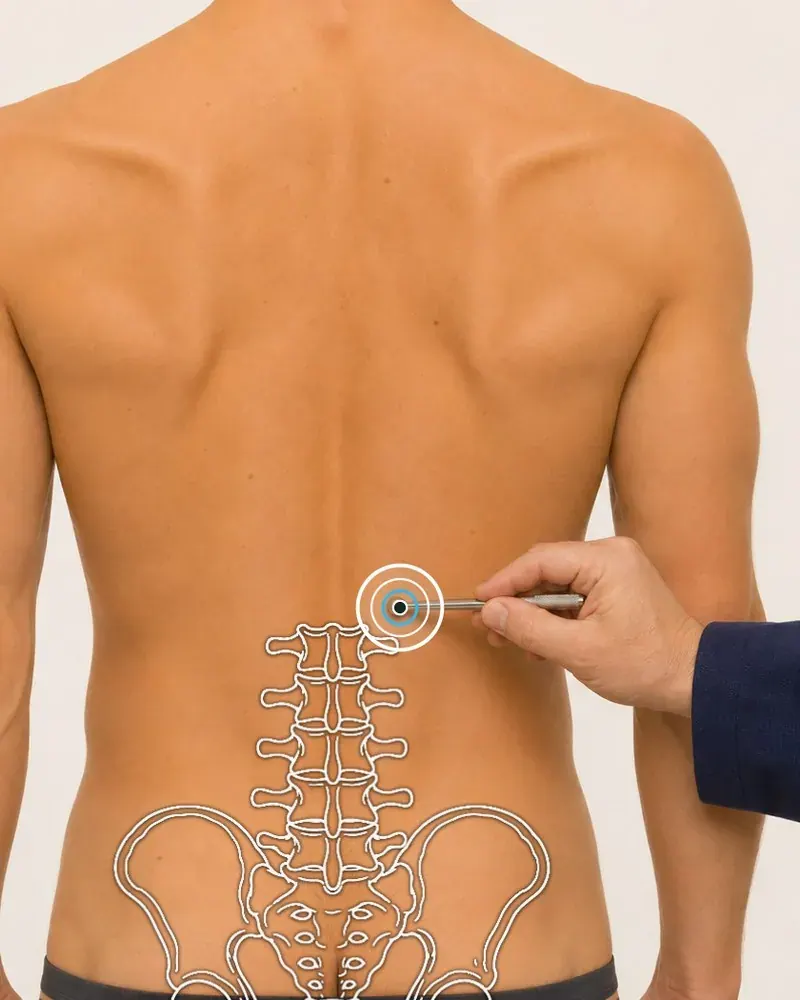
Location
On the back, 1.5 cun lateral to the lower border of the spinous process of the 12th thoracic vertebra (T12).
According to the WHO (2008): In the upper back region, at the same level as the inferior border of the spinous process of the twelfth thoracic vertebra (T12), 1.5 B-cun lateral to the posterior median line.
How to find it, step by step
Three steps with photos, from an easy landmark to the exact point. Measurements are in cun, the width of the person's own thumb.
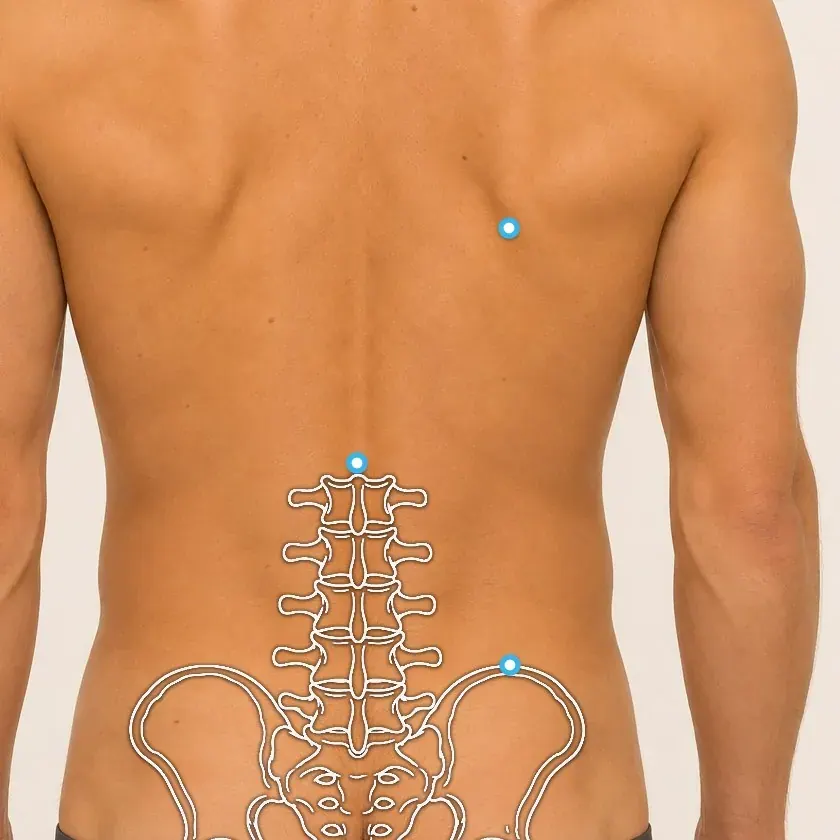 Inferior angle (T7)Iliac crest (L4)T121
Find T12
With the arms at the sides, join the lower tip of the shoulder blade (T7) to the highest point of the iliac crest (L4): halfway, on the spine, is the spinous process of T12.
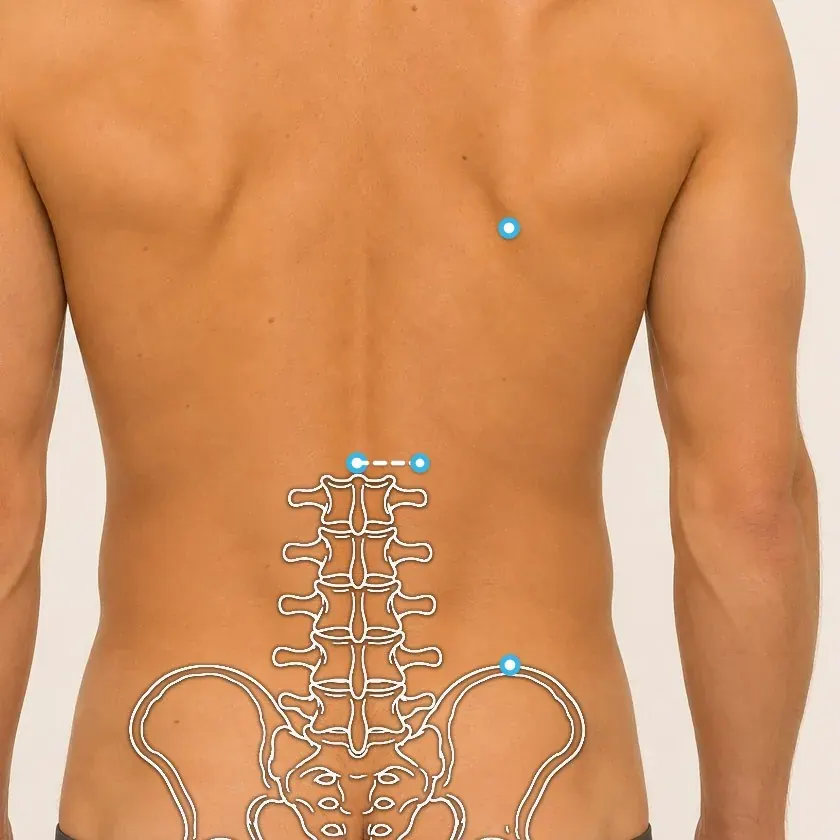 2
Go below T12 and move out 1.5 cun
Just below the spinous process of T12, move 1.5 cun to the side: half the distance to the vertical line of the inner edge of the shoulder blade. That is Wèishù.
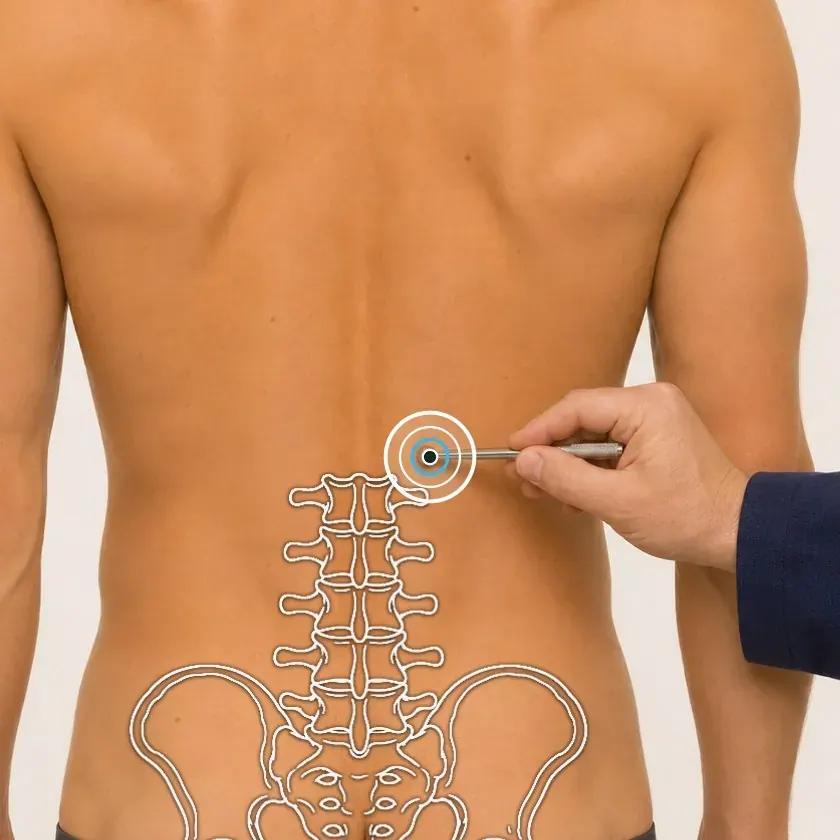 3
Press next to the spine
Angled toward the spine and not deep: the pleura reaches this level, and the kidney and spleen lie in front.
Functions according to tradition
Back-Shu of the Stomach: harmonizes the Stomach, descends rebellious Qi and resolves stagnation.
Traditional indications
- Epigastric pain
- Nausea
- Vomiting
- Poor appetite
- Slow digestion
Indications described by tradition; they do not amount to proven clinical effectiveness for each one.
What its classification means
Located on the back, on the inner branch of the Bladder channel, at the level of the organ it relates to. Tradition prefers it for chronic disorders and disorders of the zang organs.
Precautions
The pleura reaches down to T12 and the kidney lies beneath: needle obliquely toward the spine, never deep and perpendicular.
- Needling depth
- 0.5–0.8 cun
- Angle
- Oblique toward the spine
Needling must always be done by a trained professional. At home, only gentle finger pressure.
Points on other channels with similar indications
They share several traditional indications with this point. Comparing them helps understand why one or the other is chosen.
- ST19 Burong (Stomach): Epigastric pain, Poor appetite, Vomiting
- ST21 Liangmen (Stomach): Epigastric pain, Nausea, Poor appetite
- CV11 Jianli (Ren Mai (Conception Vessel)): Poor appetite, Vomiting
- CV16 Zhongting (Ren Mai (Conception Vessel)): Poor appetite, Vomiting
- KI18 Shiguan (Kidney): Epigastric pain, Vomiting
- SP3 Taibai (Spleen): Slow digestion, Vomiting
Point profile
- Code
- BL21
- Pinyin name
- Wèi Shù
- Characters
- 胃俞
- Translation
- Stomach Shu
- Meridian
- Bladder
- Element
- Water
- Classification
- Back-Shu
- Topics
- Digestion
Health notice. Educational and study content. It describes concepts of Traditional Chinese Medicine and does not replace diagnosis or treatment by a healthcare professional. Needling, medicinal herbs and invasive techniques must be applied by trained professionals. Safety guide.
