Fengfu (GV16)
Fengfu (GV16), “Wind Palace”, is a point on the Du Mai (Governing Vessel). It is point 16 of the 28 on the channel. Expels internal and external Wind, benefits the brain, calms the mind, treats aphasia and neurological disorders.
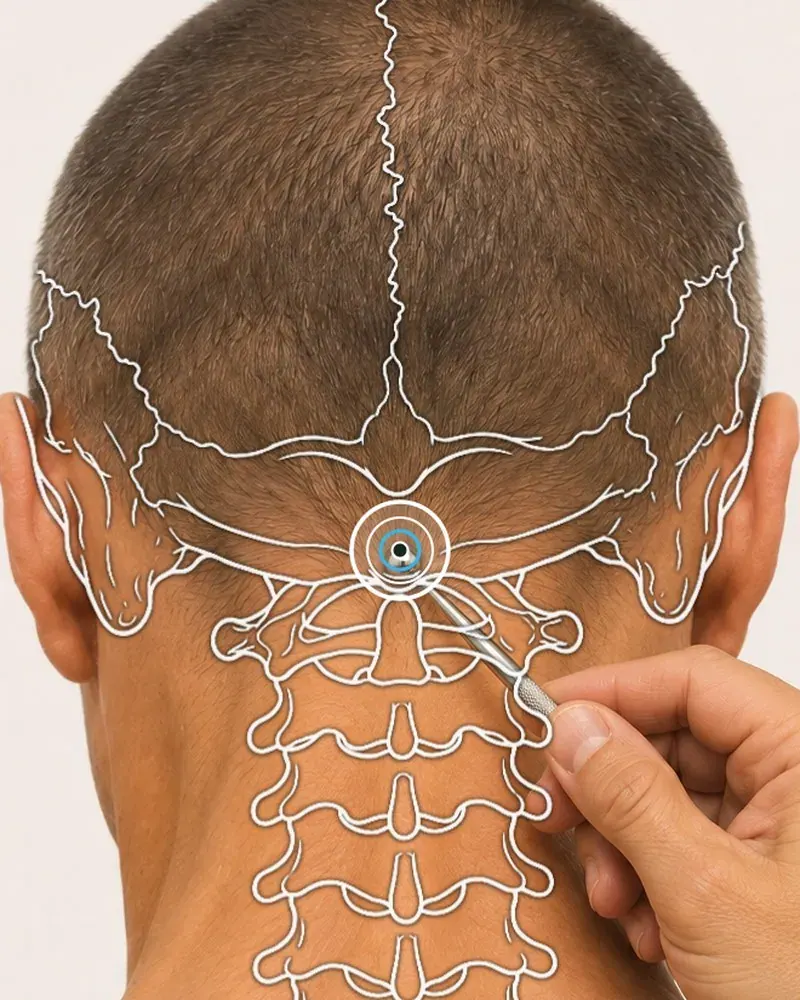
Location
1 cun superior to the midpoint of the posterior hairline, on the midline.
According to the WHO (2008): In the posterior region of the neck, directly inferior to the external occipital protuberance, in the depression between the trapezius muscles. Note: with the patient seated and the head slightly extended to relax the trapezius, move upward from the midpoint of the posterior hairline to the occipital bone.
How to find it, step by step
Three steps with photos, from an easy landmark to the exact point. Measurements are in cun, the width of the person's own thumb.
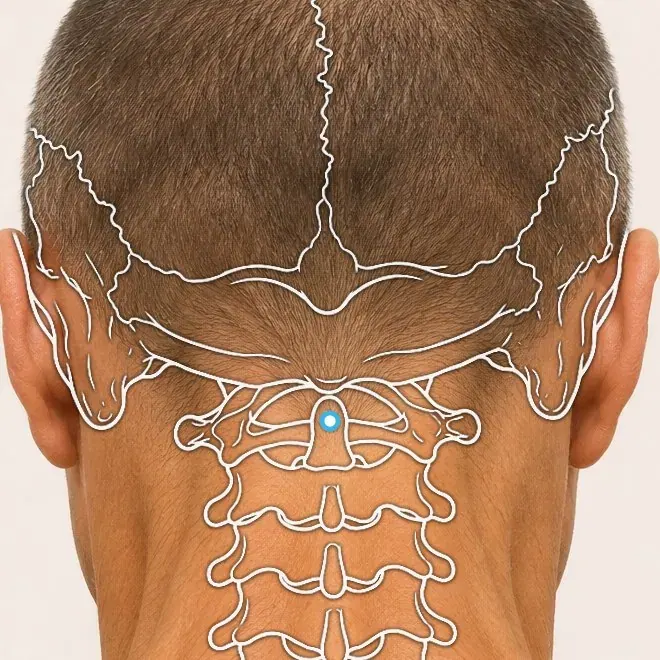 Posterior hairline1
Find the hairline at the back of the neck
With the head tilted slightly back, find the center of the line where the hair ends at the back of the neck.
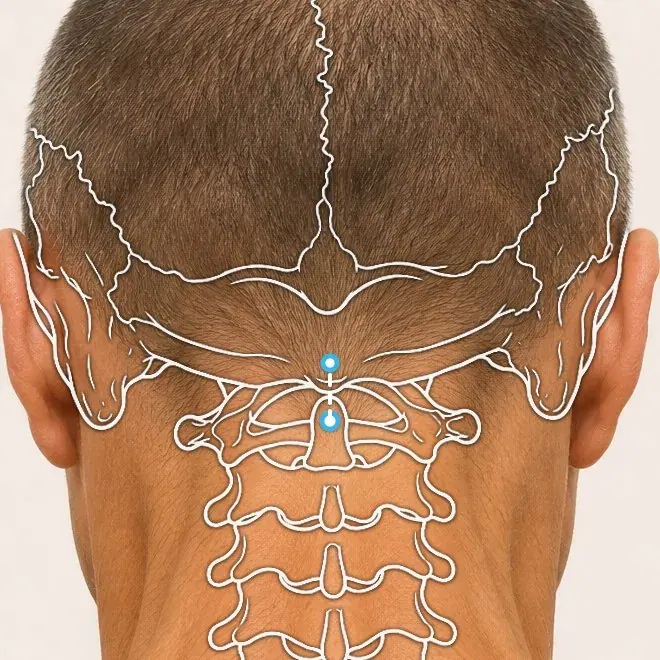 2
Go up to the bone
Go up the center, between the two cords of the trapezius, until your finger hits the bone of the skull (1 cun): Fēngfǔ is in the hollow just below.
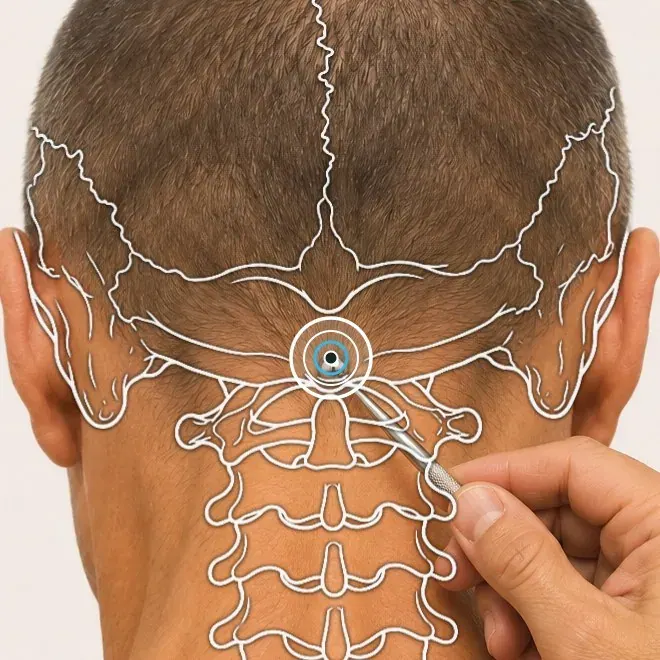 3
Press in the hollow
Gentle pressure. Needling, perpendicular or oblique toward the chin and not deep, is for professionals only: never upward (medulla oblongata).
Functions according to tradition
Expels internal and external Wind, benefits the brain, calms the mind, treats aphasia and neurological disorders.
Traditional indications
- Occipital headache
- Neck stiffness
- Aphasia
- Stroke
- Vertigo
- Psychiatric episodes
Indications described by tradition; they do not amount to proven clinical effectiveness for each one.
What its classification means
Two or more channels meet here, so it is credited with acting on all of them.
Precautions
Do not needle deeply: risk to the medulla oblongata. No deeper than 1 cun, and with control.
- Needling depth
- 0.5–1 cun
- Angle
- Perpendicular or oblique downward, never upward
Needling must always be done by a trained professional. At home, only gentle finger pressure.
Points on other channels with similar indications
They share several traditional indications with this point. Comparing them helps understand why one or the other is chosen.
- GB20 Fengchi (Gallbladder): Neck stiffness, Occipital headache, Vertigo
- BL10 Tianzhu (Bladder): Neck stiffness, Occipital headache, Vertigo
- BL65 Shugu (Bladder): Neck stiffness, Occipital headache
- BL9 Yuzhen (Bladder): Neck stiffness, Occipital headache
- GB19 Naokong (Gallbladder): Neck stiffness, Occipital headache
- BL41 Fufen (Bladder): Neck stiffness
Point profile
- Code
- GV16
- Pinyin name
- Fēng Fǔ
- Characters
- 风府
- Translation
- Wind Palace
- Meridian
- Du Mai (Governing Vessel)
- Classification
- Crossing point
- Topics
- Wind, Neck, Mental
Health notice. Educational and study content. It describes concepts of Traditional Chinese Medicine and does not replace diagnosis or treatment by a healthcare professional. Needling, medicinal herbs and invasive techniques must be applied by trained professionals. Safety guide.
